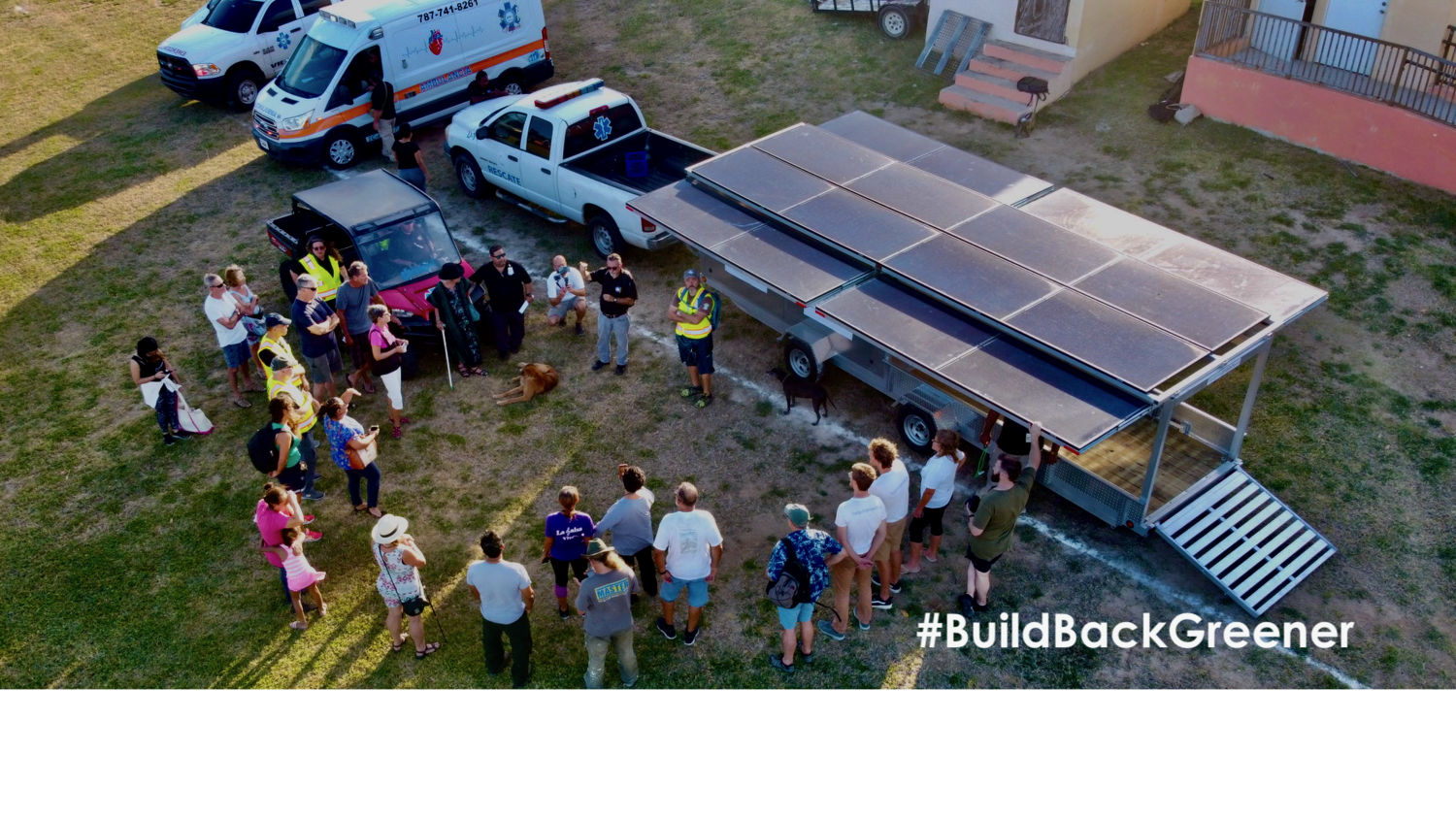
Hardware Heroes (In-kind Equipment Donations)
Who can apply: Donations of relevant hardware and sustainable response technologies; donor/company should coordinate with Footprint Project to confirm acceptability.
Provide cleaner energy for communities in crisis by mobilizing cleaner energy, decarbonizing disaster response, and empowering community resilience through mobile solar microgrids, training, and repurposed solar equipment.
Footprint Project directs its grantmaking toward cleaner energy for communities in crisis, using mobile solar microgrids, equipment reuse, and training to support disaster response and longer-term resilience. The largest recent grant in the data went to Family Life Center in Kahului, Hawaii for program support, showing how the foundation backs local organizations responding to community needs. Another sizable grant supported Higherwire in Phoenix, Arizona, while Indigenous Environmental Network in Bemidji, Minnesota received program support as well, linking the foundation’s work to both emergency power and community-based resilience efforts. The foundation’s active programs show a consistent operating model: partnerships with first responders, farms, faith-based institutions, NGOs, schools, fire stations, and government entities; repurposed solar and electrical equipment redistributed to selected organizations; and build-and-train assemblies for off-grid mobile solar generators. Footprint Project also uses Beehive Microgrids for regional resilience planning, including Western North Carolina, and supports rapid disaster response through mobile solar deployment and technical assistance. Its role is not limited to one type of recipient or one geography; the grants and programs point to a funder that combines project support, equipment, and field deployment around disaster preparedness and recovery.
In disaster-response work, Footprint Project gave $22,500 to New Use Energy in Tempe, Arizona for program support. The foundation also funded Information Technology Disaster Resource Center in Fort Worth, Texas with $5,800 for program support, reflecting its emphasis on emergency power and technical deployment. Clean-energy infrastructure is another clear theme. Footprint Project awarded $27,588 to Purpose Focused Alternative Learning Corporation in Tuba City, Arizona for program support, and $6,000 to Hijra House in Biloxi, Mississippi for program support. Those grants fit the organization’s focus on mobile solar systems, off-grid equipment, and resilience planning. The foundation also supports community-based resilience through organizational partnerships. Its grant to Indigenous Environmental Network in Bemidji, Minnesota for program support aligns with its training, capacity-building, and community resilience work.
$434K
$3M
$3.7M
$2.1M
About 14% of grants go to recipients in AZ.
Sign up for a free Kindora account to access AI-generated insights into this funder's giving patterns, decision-makers, and fit signals.
Get Started FreeFree Kindora accounts unlock side-by-side comparisons with foundations that share this funder's focus areas and giving profile.
Get Started FreeSign up free to see how well your nonprofit fits this funder, get an AI-generated pitch, and unlock similar foundations.
Footprint Project’s recent grants range from $5,800 to $178,200, with a median near $25,044 and a middle 50% spread from $9,000 to $57,366, based on the eight grants listed. The pattern in the data shows program support rather than unrestricted public grants to individuals. Recent grant records are concentrated in 2025, so the file reflects a single-year snapshot rather than a long multi-year run of recipient repeats. The foundation is a Public Charity and a Pure DAF Provider, and the active-program list shows both unsolicited pathways and invitation-based or procurement-style routes, depending on the program.
All of the recent grants listed are in the United States. Recipient locations include Kahului, Hawaii; Phoenix and Tempe, Arizona; Bemidji, Minnesota; Tuba City, Arizona; Biloxi, Mississippi; and Fort Worth, Texas. Arizona appears more than once among the named recipients, while the remaining grants are spread across other states. The foundation’s geographic scope in its active programs is primarily the United States, with some project-specific international work noted in its core supporter pathway.
The foundation supports cleaner energy and disaster-response work, especially mobile solar microgrids, off-grid power, equipment reuse, training, and community resilience. Its active programs include rapid disaster response, community builds, upcycled energy, and Beehive Microgrids for long-term resilience.
Its partnership pathway is open to first responders, farms, faith-based institutions, NGOs, and other organizations. Other active pathways involve mutual aid networks, nonprofits, schools, fire stations, government entities, and selected organizations working on disaster response and resilience missions.
Among the eight listed grants, the median is about $25,044, with most grants sitting between $9,000 and $57,366. The smallest listed grant is $5,800 and the largest is $178,200.
Yes, for some programs. The Partners pathway accepts unsolicited requests, and several Beehive Microgrids and rapid-disaster-response pathways are also marked as open to unsolicited approaches. Other programs, such as Upcycled Energy and Community Builds, are not open to unsolicited requests.
The listed recent grants all go to U.S. recipients. Named recipient cities include Kahului, Phoenix, Bemidji, Tuba City, Biloxi, and Fort Worth, with Arizona appearing more than once among the recipients.
2025
Source: IRS Form 990-PF, fiscal year 2025.
Current and upcoming funding from Footprint Project that your nonprofit may be able to apply for.
Who can apply: Donations of relevant hardware and sustainable response technologies; donor/company should coordinate with Footprint Project to confirm acceptability.
Who can apply: Organizations that can support distribution, identify needs, or host/maintain equipment; no formal grant eligibility published.
Who can apply: Who we serve includes first responders, emergency management personnel, nonprofits, and community organizations. Intended for organizations currently responding to a disaster or working without power.
Deadline: No fixed deadline; support is provided as disasters occur.
Track these deadlines, get reminders, and see how well your nonprofit fits — free with a Kindora account.
Create a free accountDeadlines and eligibility are summarized from public sources and may change — always confirm the details on the funder's official application page before applying.
Most recent grants reported to the IRS.
| Recipient | Location | Amount | Year | Purpose |
|---|---|---|---|---|
| FAMILY LIFE CENTER | KAHULUI, HI | $178,200 | 2025 | PROGRAM SUPPORT |
| HIGHERWIRE | PHOENIX, AZ | $89,940 | 2025 | PROGRAM SUPPORT |
| INDIGENOUS ENVIRONMENTAL NETWORK | BEMIDJI, MN | $71,370 | 2025 | PROGRAM SUPPORT |
| VARIOUS | — | $32,886 | 2025 | — |
| PURPOSE FOCUSED ALTERNATIVE LEARNING CORPORATION | TUBA CITY, AZ | $27,588 | 2025 | PROGRAM SUPPORT |
| NEW USE ENERGY | TEMPE, AZ | $22,500 | 2025 | PROGRAM SUPPORT |
| HIJRA HOUSE | BILOXI, MS | $6,000 | 2025 | PROGRAM SUPPORT |
| INFORMATION TECHNOLOGY DISASTER RESOURCE CENTER | FORT WORTH, TX | $5,800 | 2025 | PROGRAM SUPPORT |
| INDIGENOUS ENVIRONMENTAL | BEMIDJI, MN | $73,609 | 2024 | PROGRAM SUPPORT |
HIGHERWIRE
$89,940PROGRAM SUPPORT
VARIOUS
$32,886NEW USE ENERGY
$22,500PROGRAM SUPPORT
HIJRA HOUSE
$6,000PROGRAM SUPPORT