Grant intelligence
for every mission.
Tell Kindora what you're trying to do. It already knows you, and every funder. Starting at $0.
Nonprofits found us inside Claude, and stayed.
On April 17, 2026, Kindora launched as an MCP connector in the Claude marketplace and trended #5 across all apps that week — alongside Gmail, Drive, and Zoom. Anthropic published a case study. Zero paid marketing.
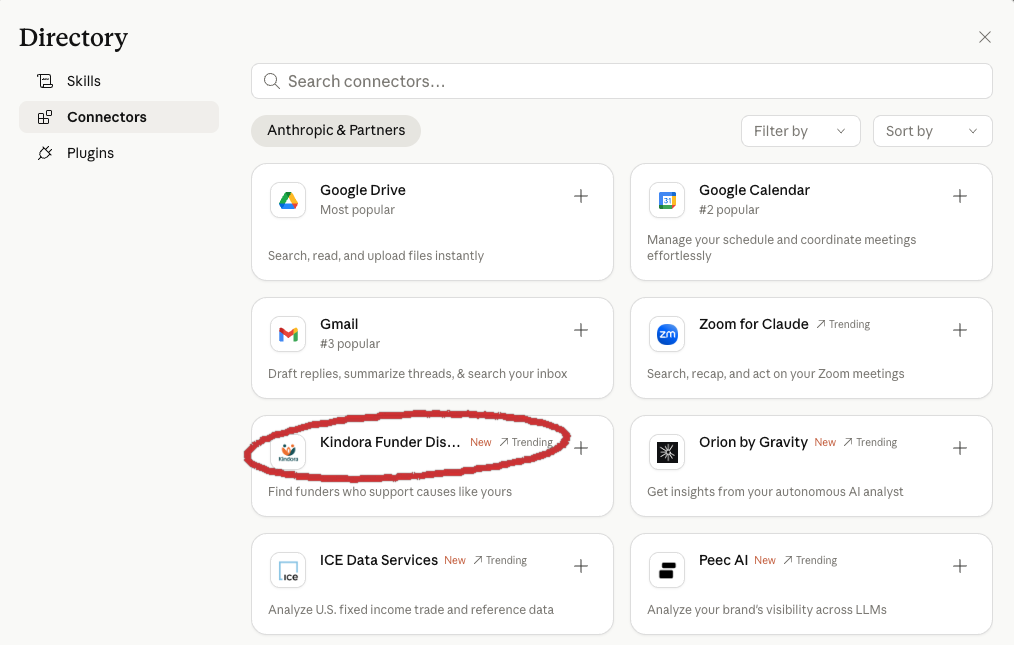
Intelehealth sent a gap analysis — we shipped country filters and a confidence score. Open Food Facts filed bug reports. An ocean-conservation writer built a landing page on our results.
Real external calls only — internal uptime monitoring and in-process backend traffic excluded, and request fingerprinting began Apr 29. Distinct human users aren’t derivable: Anthropic’s shared egress collapses all Claude.ai users behind a handful of IPs.
Built for the 85% priced out of professional fundraising tools.
"The purpose of the Corporation is to engage in any lawful act or activity for which corporations may be organized under the Delaware General Corporation Law, and to democratize philanthropic giving to under-resourced nonprofits."Filed July 15, 2025 · Delaware Sec. of State
of nonprofits are priced out of the funder-research tools that fundraising professionals take for granted — and they're disproportionately the organizations closest to the communities they serve.
Full-feature platforms cost $300–$500/mo with mandatory annual contracts.
77% of Black-led nonprofits operate on under $500K a year. The math doesn't pencil.
Kindora is a Delaware PBC. Our charge is legal, not marketing — democratize philanthropic giving.
An executive director spends 60% of her week looking for money instead of doing the work.
The funding exists. $120B in foundation grants. Hundreds of billions in federal grants. But finding the right grant — and writing it well — has stayed a manual, expensive, time-consuming job. And every new tool comes with its own learning curve, paid for in the same scarce hours.
A full week of work — prospecting, scoping, formatting — just to build the list. Multiply by every cycle.
The majority of nonprofits track their fundraising in Excel. The professional tools are 5× their software budget.
Annual contracts required. Lower-cost databases exist, but mostly stop at search.
Ask for an outcome. Get a result.
Most tools stop at search. Kindora doesn't make you operate anything — you say what you're trying to do, and structured results come back: match cards, drafts, network maps, prospect lists. Edit them, approve them, or take the wheel.
Every result shows its sources. Switch to manual search and sort any time — power users keep the wheel.
Funder matches that think like a program officer.
Tell Kindora what your programs are. It returns funders that fit — each one scored across mission, geography, giving history, and program-level alignment, with the reasoning shown. No search interface to master.
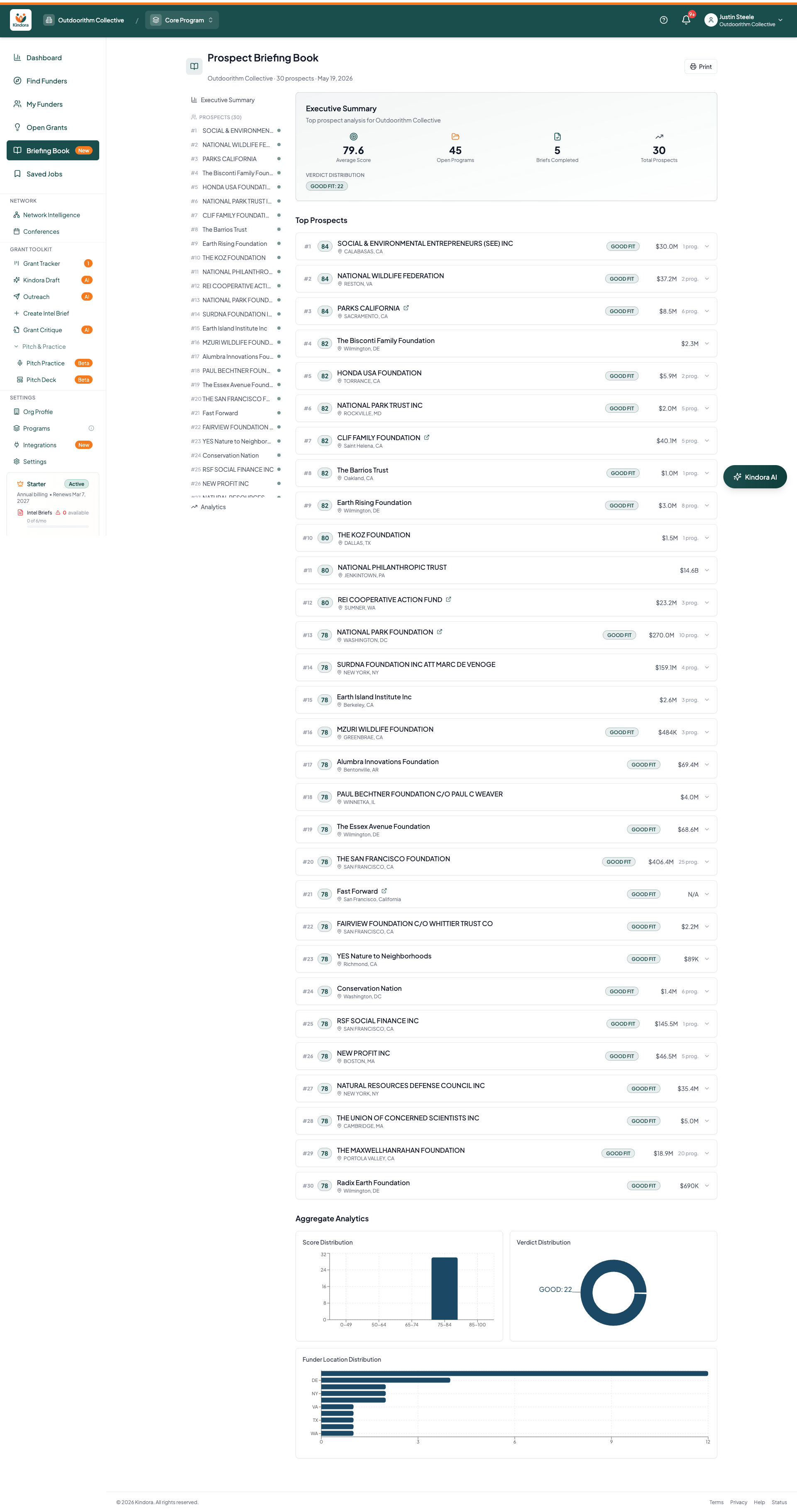
Ask once. Get the whole package.
A complete strategic briefing on any funder — generated from verified giving data and current-year context, in one ask. The analyst's deliverable, without the analyst.
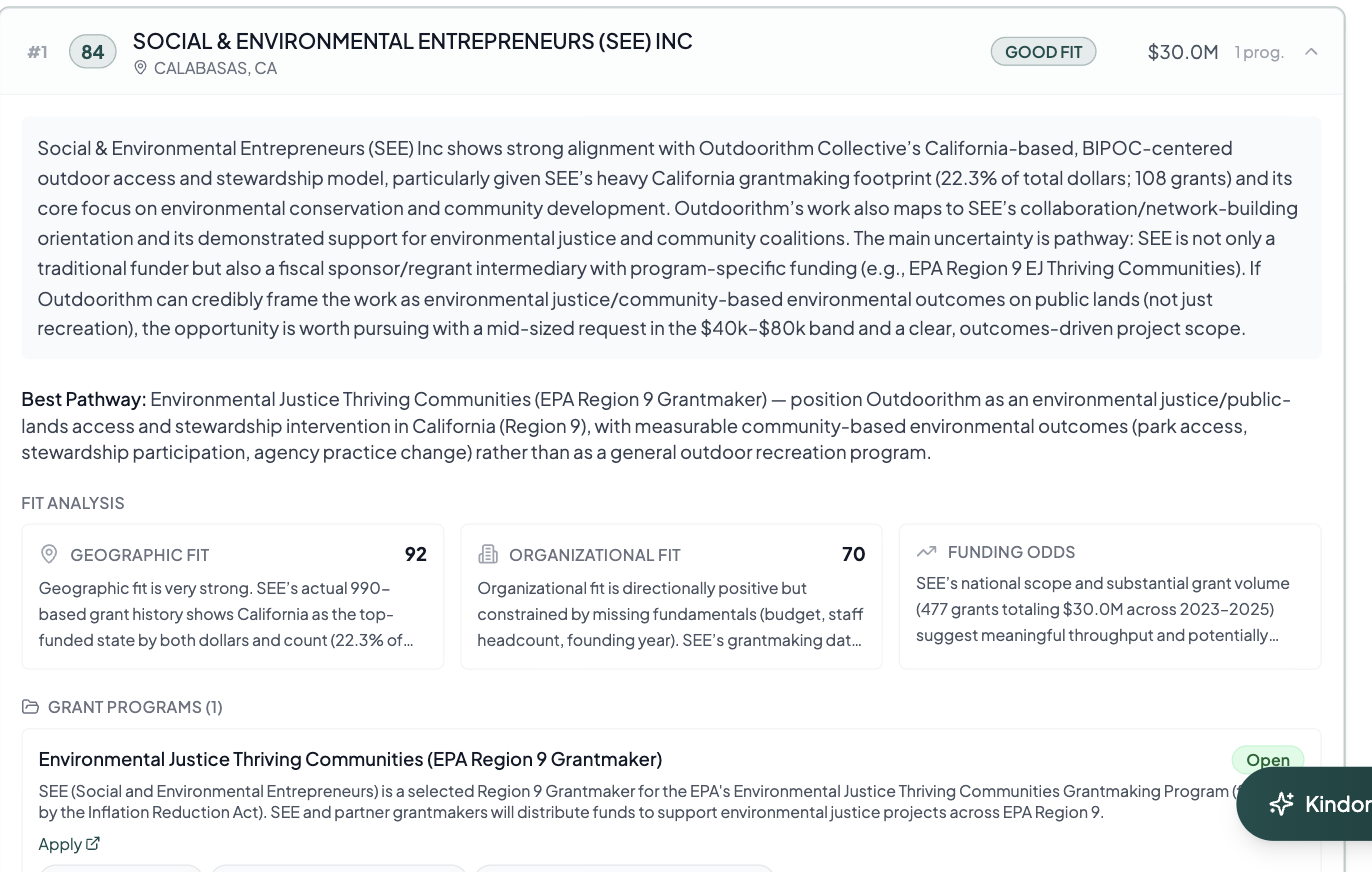
Agentic by default. Manual whenever you want.
Nonprofit leaders are accountable to boards, auditors, and funders for what gets submitted. Kindora is built for that: every answer is sourced, every action is approvable, and the wheel is always within reach.
See every source.
Every match, draft, and recommendation shows the underlying data it used — 990-PFs, board rosters, prior gifts. Click any claim to inspect the trail.
Approve before it ships.
Outbound actions — emails, applications, status changes — sit in a pending queue. Nothing leaves your account until you say yes. Reversible by default.
Take the wheel, any time.
Manual search. Manual sort. Manual draft. One click switches the surface from agentic to direct manipulation — for the comparison and analysis tasks where it matters most.
The user is the orchestrator, not the operator. Scoped delegation, verifiability, reversible defaults, the ability to verify what was done on your behalf.
— a16z, "Agency by Design," 2026 · the principle Kindora is built onMost of philanthropy is individual giving. We help nonprofits see the donors already in their orbit.
Individual giving is 72% of US philanthropy. Kindora's enrichment pipeline turns a nonprofit's CRM into a scored, segmented database with cultivation plans — a $10K–$50K product line in production today.
18,970 donor contacts → a prioritized board-level cultivation plan.
Nonprofit-controlled, always. We never sell donor data. No foundation sees a grantee's donor pipeline. Enrichment runs only with the org's explicit consent.
Buy Kindora for your whole portfolio — and let go of the part you don't fund.
Camelback Ventures
Active fellowship cohort (Justin, Class of 2026). Portfolio license in scoping.
Three guardrails on every enterprise deal.
Grantees control their accounts.
Foundations cannot see what their grantees are searching for, who they're pursuing, or what their strategy is.
The whole point is diversification.
We help grantees find other funders — beyond the foundation that bought the license. Dependency is the failure mode.
We test every deal: shift power or look like it?
If a foundation wants to monitor grantee activity or constrain pursuits, we walk away.
Per-org pricing, volume-discounted.
Platform fee for foundations with 20+ grantees: $2.5K–$5K/yr (portfolio dashboard, dedicated onboarding, annual impact report). Multi-year incentives apply.
The only platform that spans grants and donors — with the deepest workflow inside Claude.
Instrumentl will match us on weekly opportunities. DonorSearch will match us on wealth signals. No one matches us on both — and only Kindora runs the full grant workflow inside Claude.
| Kindora | Instrumentl | Candid | GrantStation | DonorSearch / iWave | |
|---|---|---|---|---|---|
| Entry price | $0 forever | $179 / mo | $37 / mo | $95–199 / yr | $1K–$5K+ / yr |
| Agentic interface (ask → output) | ✓ · Full workflow (discovery → donors) | drafting only (Apply) | — | — | — |
| Inside Claude (MCP) | ✓ · Full workflow · #5 at launch | — | ✓ basic search, beta | — | — |
| Weekly opportunity feed | ✓ + full pipeline | ✓ + database | database only | database only | — |
| Funder-tailored drafting | ✓ · Full drafts | answer resurfacing | LOI writer | — | — |
| Intel Briefs (5-doc package) | ✓ | — | — | — | — |
| Pitch Practice (voice + coach) | ✓ | — | — | — | — |
| Individual donor enrichment (9-source) | ✓ · dashboards + plans | — | — | — | static wealth screening |
| Annual contract required | Never | Required | Annual default | Required | Required |
| Years in market · brand maturity | Since 2025 | ✓ 7+ yrs, established | ✓ decades | 20+ yrs | 10+ yrs |
We're new. The incumbents have deeper databases and longer histories — and they were built when the cost of intelligence was high. Kindora is built for the cost curve that came after.
A live product, used every day, by the people we built it for.
Since the April Claude launch: 1,560 organizations and 2,220 users — with a published Anthropic case study and a fast-growing base of organizations. Almost all of it word-of-mouth.
As a solo founder with no staff, Kindora helped me target the right funders and draft applications in a fraction of the time. 74 grants submitted, $100K raised in year one.Sally SteeleFounder & CEO · Outdoorithm Collective (Founding design partner · spouse of co-founder Justin Steele)
Kindora is very cool. I am helping people at the Sunset Post […] find funding opportunities to help them sustain. Kindora made the search incredibly easy.FM Fiona MaazelNovelist & advocate · Sunset Post · quote used with permission
The day you launched on Claude, I got onboard. 3 new funding opportunities open to us right now — 2 of which I had never heard of. Thank you.ME Maggie EhrenfriedDevelopment professional · LinkedIn DM, May 5 2026
Kindora offers the ability to search for program-related investments (PRIs) too. I have never seen a database this rich of funders across multiple asset classes.JS Joanne SonenshineFounder, Connective Impact · LinkedIn, April 18 2026
 AWS
Deloitte
AWS
Deloitte
Built by people who've been on both sides of the grant table.
Justin spent nearly a decade directing philanthropic capital at Google.org — the buyer's seat. Karibu architected the platform from the operator's seat. The PBC structure is not branding; it's filed.
"…to democratize philanthropic giving to under-resourced nonprofits."Delaware Cert. of Incorporation · Article III
Justin Steele
Directed $698M in philanthropic investments at Google.org over nearly a decade. Led the Americas portfolio. Deputy Director at Year Up. Consultant at Bain & Bridgespan. Harvard MBA / MPA, UVA engineering.
Karibu Nyaggah
Leadership experience at Meta focused on AI transformation. Co-founded Sinapis, scaling programs for 7,000+ entrepreneurs across 6 countries. Chief of Staff at Alphabet's Loon. World Bank consultant. Harvard MBA.
Priced for the 85% — built for everyone.
Full-feature grant platforms can start at $179/month with annual contracts. Kindora starts at zero — and every credit is work done for you: an application drafted, a funder researched, a pitch coached.
Explore
- 219K+ funders
- 3 Intel Briefs
- 150 credits — ≈ 1–2 applications
- Full search
Starter
- 6 briefs / month
- 250 credits — ≈ 3 applications
- 2 seats
- Pipeline view
Growth
- 10 briefs / month
- 500 credits — ≈ 5 applications
- 3 seats
- Full pipeline + network mapping
Pro
- 30 briefs / month
- 2,000 credits — ≈ 15 applications
- 8 seats
- Collaboration + exports
Consultant Plus
- 60 briefs / month (pooled)
- 4,000 credits (pooled)
- 12 seats · 10 orgs
- White-label + API
- Solo plan from $99/mo
Foundations & networks
Help us close the gap between proximity and power.
1,560 organizations and 2,220 users found us since the April launch, most by word-of-mouth. Camelback, Anthropic, and dozens of fundraisers told us the same thing: this is the moment to build the philanthropy data backbone.
What thoughtful skeptics push back on, and what we say.
These are real critiques from people who watched the launch closely. We engage them on the merits — these are the answers we use in the room.
"Funding partnerships aren't found — they're grown."
Agreed — and we don't replace the relationship, we equip you to start it. Board-network mapping shows the warm path, Pitch Practice rehearses the conversation, Intel Briefs give you the language. The match is a starting line; the cultivation is still yours to do.
"I got a more useful response from Claude directly."
Vanilla Claude doesn't see live funder data — open deadlines, eligibility today, the 50K URLs we scrape weekly. That's exactly why we shipped as an MCP connector. We're the philanthropy layer inside Claude, not a replacement for it.
"Are you conflating need with demand?"
Yes — search behavior is demand, not need, and we're careful to say so. But it's the strongest signal anyone has on what nonprofits are actually pursuing. We make match quality observable; the funder still decides what to fund.
"Isn't this just another chatbot?"
A chat box with no affordances is a bad interface — we agree. So Kindora returns structured output: match cards, comparison tables, drafts, network maps, prospect lists. Chat is how you ask. The answer is something you can act on.